Alternating Current (AC)
What Is an Abnormal Failure in a Power Supply?
An abnormal failure is an artificially induced failure of a component, usually as a result of abnormal testing for regulatory agency safety compliance.
What Is Alternating Current (AC)?
AC: An electric current that continually reverses direction.
AC is the short form for Alternating Current, in which the electric charge reverses direction at regular intervals to produce alternate positive and negative values of the same magnitude.
The alternating current follows a sine waveform where the voltage increases steadily from zero, rising to the maximum positive peak voltage. It then reverses and drops down through zero into the negative direction until it reaches the negative peak value, which is equal to the positive in magnitude and only different in polarity. The voltage reverses again and climbs toward the zero point to complete one cycle. This process repeats at the rated frequency of either 50 HZ or 60 HZ (cycles per second).
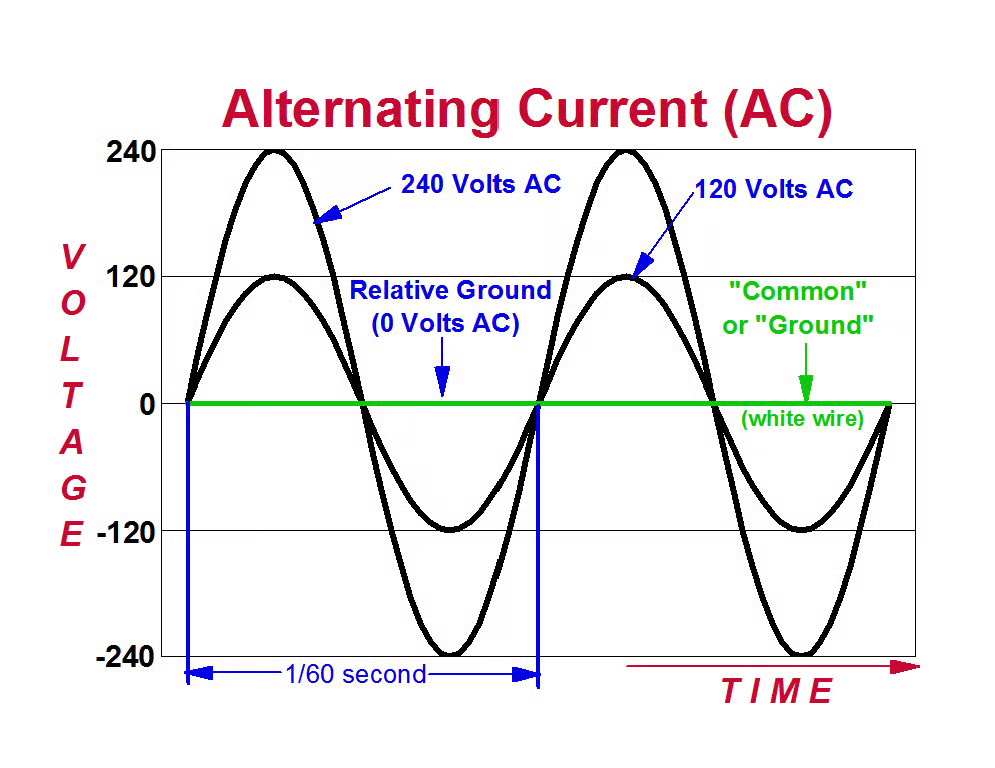
The rate of reversing direction is quantified by the number of complete cycles per second and is known as the frequency. The two commonly used frequency standards for domestic and industrial applications are 50 Hertz, which is used in most parts of the world, and 60 Hertz, used in the USA and some other regions.
The other frequency is 400 Hz. This is used in aircraft, spacecraft, marine, military and other sensitive applications where light equipment and higher motor speeds are desired.
The AC is generated using hydro, diesel, steam or wind turbines. Other sources are renewable energy sources such as solar; however, some of these produce direct current and must be inverted to alternating current before being fed into the grid.
The alternating current is the common form of electrical power generated and distributed due to its ease of generation and distribution. The alternating voltage is easily stepped up and down to suit any required voltage level. To minimize power losses in the conductors, the electrical power is transmitted at high voltages and low currents. This is later stepped down at the distribution and consumer level to suit the consumer’s needs.
The majority of electrical and electronic equipment use AC power at either 220-240 volts or 110-120V for domestic and office applications and 415V for industrial. However, most of the equipment and especially all electronics, use external or internal power supply units to convert the AC into the appropriate direct current (DC) required by the electronic devices and circuits.
AC is normally supplied to equipment using three wires:
- The hot wire transmits the power.
- Neutral provides a return path for the current in the hot wire. It is also connected to the earth.
- The third wire is the ground, which is also connected to the earth. This is connected to the metallic parts of the equipment to provide safety and eliminate electric shock hazards.
The abnormal failure tests include subjecting the semiconductor components to extreme temperature, excess voltage or current and simulated fault conditions such as short circuits. This checks whether the devices can withstand worst case conditions that may arise in practical applications.
In addition, abnormal fault responses are used by the manufacturers to improve on the design and eliminate dangers that may arise from fires arising from excessive temperatures generated under the fault conditions.
According to IPC-9592, Performance Parameters for Power Conversion Devices regulations, the following is expected;
“Abnormal Testing (Protection, Brownout, Load and Startup Tests) – AC/DC Devices Only. NOTE: Under no conditions shall smoke, burning, the smell of burning or flames be permitted as a result of failures found in any testing.”
Electronic devices are required to comply with international regulatory standards on safety, environmental impact, and electronic interference.
The components or equipment may be subjected to:
- Low and high temperatures
- Cyclic temperatures
- High humidity
- Ac noise tolerance
- Electrostatic discharge test
- Instantaneous power interruption
- Voltage fluctuation i.e. ±15%
- Frequency fluctuation ±5Hz
- Lightening surge test 8kV
- vibration test
- Short and open circuit tests
- Insulation resistance
- Leak current test
- Current consumption at full load
- In rush current
- Terminal noise voltage
Component Temperature Rise Test
The maximum rated current is applied to the component, after which a thermographic camera is used to analyse the thermal distribution as the temperature rises on each component.
Open and short circuit Tests
Deliberate short and open circuits are created on the circuit, and a thermographic camera is used to check for abnormal thermal emissions. The test is done to ensure that the design conforms to standards and that there is no danger of fire ignition from such faults.
Any abnormal thermal emission and other safety issues should be addressed by the use of a better design and components. All countermeasures in the event of failures should be effective and safe whenever a fault occurs.