Rethinking Energy Use in Battery Testing and DC Systems with BIC-5K
In battery testing, energy storage and energy conversion, wasted energy is an issue that comes up again and again. Whether you're working with standalone battery systems or integrated power architectures, inefficiencies during testing and simulation can quickly add up, both in terms of cost and system complexity.
When discharging batteries or simulating load conditions, traditional setups convert that energy into heat through resistive or electronic loads. That leads to higher operating costs, added cooling requirements and unnecessary energy loss across the system.
In high power environments, this inefficiency compounds and becomes difficult to ignore. As power levels increase, so does the amount of wasted energy, placing greater strain on both the electrical and thermal design of the system. Over time, this not only impacts energy consumption but can also affect component lifespan, system reliability and overall operational efficiency.
MEAN WELL BIC SERIES
The MEAN WELL BIC Series is built to address this challenge head on. Available in two models, rated at 2.2kW and 5kW, these units operate as both an AC to DC power supply and a DC to AC inverter, allowing energy to move freely in both directions depending on the application.
Instead of dissipating energy during discharge, the system captures it and feeds it back into the grid. What would traditionally be lost as heat is now recovered and reused, reducing overall energy consumption and easing the load on supporting infrastructure such as cooling systems.
This shifts the way engineers think about system design. Discharge is no longer something to manage or minimise, it becomes an active part of the energy cycle. By closing that loop, systems become more efficient, more controlled and far better suited to high power testing, storage and conversion environments.

EXPANDING BEYOND TESTING: ENERGY CONVERSION IN REAL SYSTEMS
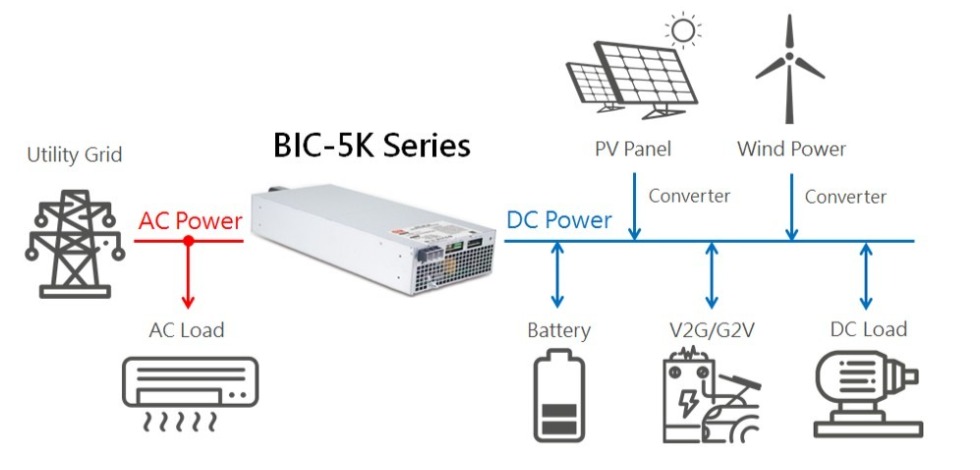
While battery testing is a key application, the BIC-5K is equally relevant in wider energy conversion systems. In many modern installations, AC and DC systems are required to operate together. This is common in:
- energy storage systems connected to the grid
- hybrid power setups combining renewable generation and batteries
- DC distribution environments where controlled power flow is required
In these scenarios, the BIC-5K acts as a controlled interface between AC and DC. It allows energy to move in both directions depending on system demand.
This means it can:
- charge batteries from an AC source
- return stored energy back to the grid when required
- support stable DC bus operation
Rather than being limited to test environments, it becomes part of a wider system where energy needs to be managed efficiently and predictably.
HOW THE BIC-5L WORKS IN PRACTICE
At its core, the BIC-5K operates in two modes, depending on system requirements.
In charge mode, it converts AC input into a stable DC output, supplying power to charge batteries or support DC systems.
In discharge mode, it does the reverse. DC energy from a battery or system is converted back into AC and returned to the grid.
The transition between these two modes is extremely fast, typically under 1 millisecond. In real terms, this means the system can respond instantly to changing conditions without interruption.
For engineers, this opens up a more flexible way to design:
- battery charging and discharging cycles within a single unit
- reduced need for separate power supplies and loads
- improved control over system behaviour
Rather than building systems around energy loss, you’re now designing around energy reusability and minimizing energy loss in the process.
KEY TECHNICAL FEATURES
The BIC-5K is built for high power applications where performance, control, and efficiency all matter.
Key specifications include:
- 5kW bidirectional power conversion
- AC input range of 180 to 305VAC
- High efficiency up to 93.5%
- Power factor up to 0.99 with low total harmonic distortion
- Fast switching between charge and discharge modes in under 1ms
- Built-in CANBus and Modbus communication for system integration
- Parallel capability up to 30kW using multiple units
- Support for three phase system configurations
These features allow the unit to integrate into both standalone and larger scale systems without complex redesign.
SOLVING A REAL PROBLEM: ENERGY WASTE IN TEST SYSTEMS
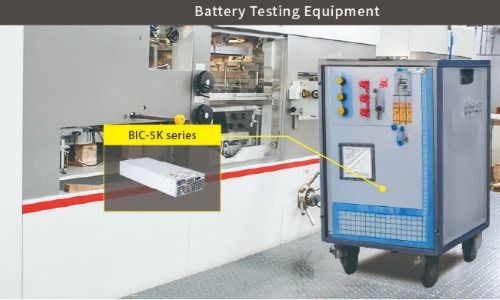
One of the biggest advantages of the MEAN WELL BIC-5K Series becomes clear in battery testing and validation environments, where energy flow is constant and often difficult to manage efficiently.
Traditionally, when a battery is discharged during testing, that energy is burned off as heat using external loads. The system has no mechanism to recover it, so it’s simply dissipated. This brings a number of practical challenges:
- large load banks to handle the power levels involved
- additional ventilation or cooling to manage heat buildup
- higher energy consumption from the grid to sustain ongoing test cycles
As power levels increase, these requirements scale with them, adding both cost and complexity to the setup. With the BIC-5K, that process changes completely.
Technical expertise just one phone call away!
Our technical team is eager to discuss how these considerations can be applied to your specific needs. Contact us today to start a conversation about your customised power supply project..